
Archuleta Police Blotter Source
Bookings across multiple days come from one place. The official ACSO Weekly Intakes page posts the list along with a linked current PDF. Sheriff's staff describe the material as public notice of arrests, dates, times, arresting agencies, charges, and bond. Entries roll forward in a weekly format. The list is not a log of every law-enforcement contact in Archuleta County, nor a lasting archive of people released.
More than one agency can fill the PDF. Names seen in the intake material include ACSO, Pagosa Springs Police, Colorado State Patrol, and Parks and Wildlife. That field shows who made the arrest. It does not reveal where someone is held today. ACSO still runs the Archuleta County Detention Facility regardless of which agency made the arrest.
Want the direct entry point? The sheriff's Weekly Intakes page connects to both the current PDF and JailTracker. One visit covers both booking sources.
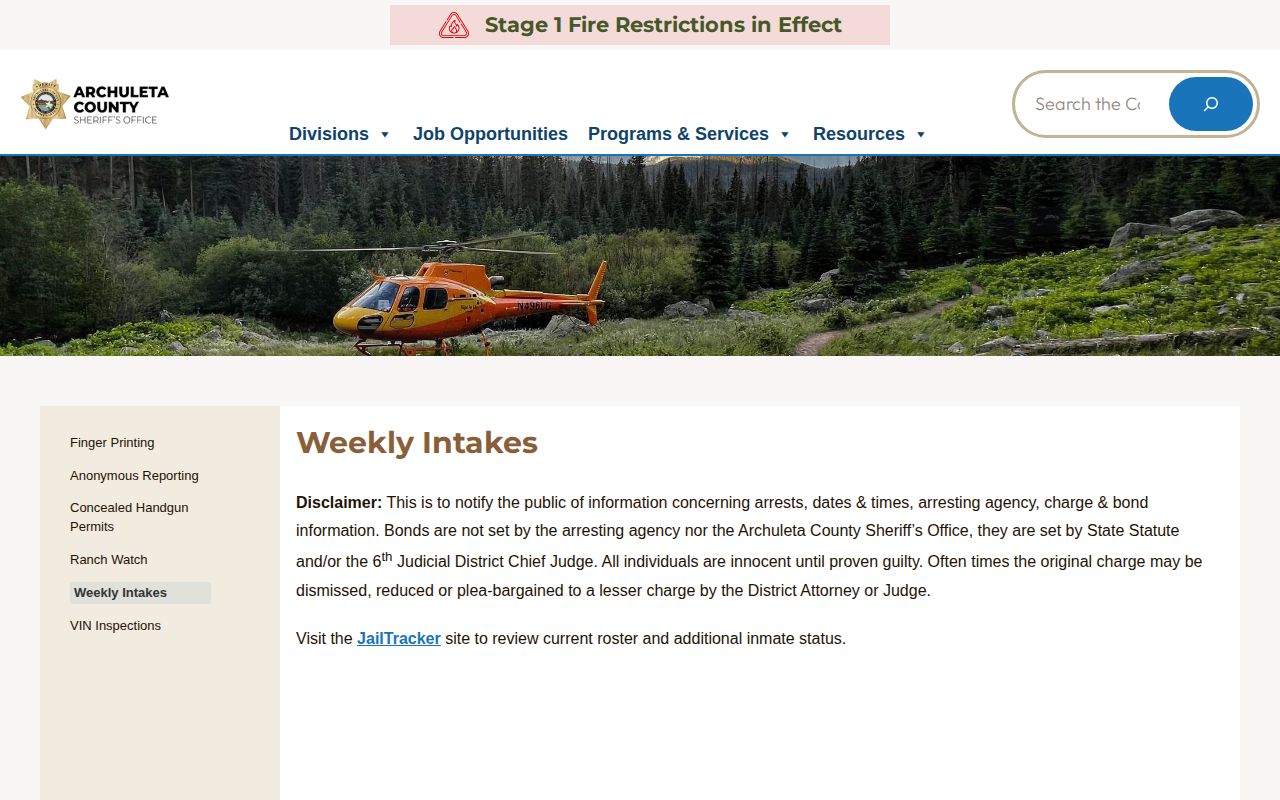
This is the official page. The linked document lists current entries. Its contents can shift at any time.
Read Archuleta Weekly Arrests
Treat each intake as a dated booking entry. It is not a case history. Start with the person heading and the booking date. Then pull the charges apart from the arresting agency and the bond notation. One intake can carry several charges, and bond language such as cash, surety, or personal recognizance records a type shown at that stage; a pending bond is not the same as no bond.
- Open the sheriff’s Weekly Intakes landing page, then use its current PDF link rather than an old saved file.
- Check the dates inside the PDF to learn the actual span covered by that version.
- Match the person by exact name, then record the booking date and arresting agency.
- Read all charge lines and the bond notation without treating either as a final court ruling.
- Use JailTracker for present custody or ACSO Records when the entry has rolled off.
The web address stays the same. The PDF behind it can change. Save the date you checked plus any dates printed in the document, since repeat searches go faster with that record. For an arrest newer than the weekly list, the Arrests Last 24 Hours route covers the live roster and detention contact.
Archuleta Arrest Entry Fields
An intake line carries fewer fields than a full sheriff file or court case. The details are thin. Names, dates, charges, agencies, and bond give enough to identify a booking. They also route the next check. Location and case results need another source. The document itself warns that original charges may later be dismissed, reduced, or pleaded down. Expect the line to mark the booking, not the ending.
| Entry field | Meaning and limit |
|---|---|
| Person name | The name printed for the intake; verify spelling and identity through the official record. |
| Booking date | The intake date, which may differ from the incident date or publication date. |
| Reported charge | The charge entered at booking, not a conviction or final disposition. |
| Arresting agency | The agency tied to the arrest, not necessarily the current jail or case custodian. |
| Bond | A pending status, type, or amount shown when the document was prepared. |
| Photograph | The PDF is not documented as a photo feed, and no image should be assumed. |
Bond does not come from the arresting officer. ACSO does not set it either. State law and the Sixth Judicial District control that decision. A later court docket can reword the charge. It can also change the bond amount. Hearings, pleas, dismissals, acquittals, and convictions live in the court record, not the intake line. That docket is where a case's path actually unfolds.
Note: An intake line records a booking event only, so use it as a starting point for follow-up with the agency or court.
Archuleta Weekend Arrest Posting
Weekend activity can appear in the document. It spans several days at once. But that proves no upload schedule. ACSO posts no fixed hour, holiday calendar, or revision log for Weekly Intakes. Check the date range printed in the current file rather than assuming it always covers the prior seven days.
A weekend or holiday can separate four events: the arrest, jail intake, the JailTracker listing, and the next PDF. Court dates follow their own clock. Someone can leave custody while the intake still sits in the rolling document. The roster often runs ahead of the PDF. Timing urgent? Call detention at 970-264-8474 instead of guessing at an unpublished lag.
Neither the roster nor the PDF carries a public retention or refresh policy. Read absence carefully. It may reflect timing, transfer, release, correction, withholding, or roll-off. A gap never proves an arrest did not happen.
Archuleta News Blotter Differences
The Pagosa Springs SUN runs a recurring feature called "The Blotter." It groups calls by date. Location and type get their own slots too. ACSO activity and Pagosa Springs Police activity even get separated. This is community news, not a custody list. An item may name no one. It may involve no booking, so it cannot confirm an arrest by itself. Read it for local context and as a lead for an agency request. The difference shows on The Pagosa Springs SUN site.
A newspaper reports an arrest. It never holds the booking record itself. The Archuleta County jail record belongs to the sheriff's office. The Durango Herald covers selected Pagosa Springs and Archuleta County investigations, and the Pagosa Daily Post has reported on selected arrests along with public-record and body-camera disputes. Neither outlet runs a full booking stream. Their story cadence is case by case. When a news story and the jail's intake sheet use different terms for the same person, take the extra step: confirm the booking with ACSO, then check later case status with the court. For a sample of regional reporting, see the Durango Herald's Pagosa Springs case coverage.
The article shows story-based coverage. It reads well but proves nothing official. A roster or booking document still matters more.
Unofficial Archuleta Arrest Indexes
Commercial arrest indexes can outlive the sheriff's own PDF. RecentlyBooked maintains an Archuleta County section with booking cards from a recent window. Arrests.org runs a county page too. It filters by date, month, year, agency, and Pagosa Springs. Those layouts belong to the private sites, not to ACSO. Neither one guarantees the sheriff's posting schedule. Neither certifies completeness, corrections, or who is still in custody. Official records come first. When a private result surfaces a name or a date, circle back to Weekly Intakes, JailTracker, ACSO Records, and the court. A copied booking photo or charge can be stale even when the page wears a fresh site timestamp. The RecentlyBooked Archuleta section is that kind of lead. Check its cards against the originating record every time. Note: A private archive can supply a lead, but only the originating agency and the court can confirm the underlying record and its outcome.
Recover Older Archuleta Arrest Logs
The sheriff's page posts no complete historical index of older bookings and says nothing about how long a roster entry stays online. Once a booking drops out of the live and rolling windows, a records request is the path. Start with the ACSO Records process. Include the person's full name, the approximate booking date, and the arresting agency, plus any case, report, or booking number. Say what form you want. Inspection, an electronic copy, or a paper copy are the usual choices. Colorado's sheriff retention schedule is a model, not proof of local policy. It names useful categories. One is a daily record of jail commitments and discharges, and another is the inmate file, which may hold arrest records, mugshots, fingerprints, and release orders. Retention periods vary by record type. ACSO does not say which schedule it adopted. Ask which schedule governs the record and whether it stayed local, was transferred, is sealed, was withheld, or was destroyed under an approved rule. Pagosa Springs Police arrests need a separate request to the town for the incident record. Later case action belongs to the Archuleta Combined Court. The online docket has a limited window. Older documents may require a trip to the clerk. CDOC matters only after a move into state corrections, while federal and immigration systems track their own custody. The Archuleta County booking-record overview maps these layers.